
Master Biology with an Expert Online Biology Tutor MTK Tutoring
An online biology tutor should help you understand how living systems work, explain your reasoning, and tackle unfamiliar questions—not simply finish a worksheet. This guide covers choosing biology study help, preparing for productive sessions, and connecting difficult concepts to practical study habits. If you’re considering MTK Tutoring, use it to shape a conversation about your course, goals, and support needs.
How can an online biology tutor help you understand biology?
An online biology tutor can work with you on the point where understanding breaks down: an unfamiliar term, a confusing diagram, a missing prerequisite, or the reasoning behind an answer. Set a specific goal, such as explaining a process without notes or interpreting an unfamiliar experiment. That gives both you and the tutor something concrete to work toward.
Start by describing what happens when you study. “I understand the explanation but cannot answer questions alone” calls for a different session than “I don’t understand what these words mean.” Bring an example of the difficulty rather than assuming you need to review an entire chapter.
Ask for a session that moves beyond explanation into recall and application. Retrieval practice—trying to bring information to mind rather than immediately rereading it—supports learning, especially when paired with feedback. A tutor can build this into the conversation by asking you to explain an idea before reviewing your notes together. (cmu.edu)
Choose support around the problem you need to solve
When comparing biology tutoring online, distinguish between ongoing support, occasional appointments, and broader course instruction. Treat these as options to ask about, not assumptions about any provider’s availability or services.
Ongoing tutoring
Consider recurring sessions if you want to revisit earlier material, work through current lessons, and review independent practice. Ask whether you can work consistently with the same tutor.
Occasional help
Consider a focused appointment for a particular topic or assignment. Confirm booking times and response expectations; “online” does not necessarily mean immediate access.
Exam-focused preparation
Bring the assessment scope, teacher guidance, and previous feedback. Ask for practice that reveals reasoning gaps, not just a rapid review of definitions.
Course-based instruction
Consider recurring sessions if you want to revisit earlier material, work through current lessons, and review independent practice. Ask whether you can work consistently with the same tutor.
Choose the smallest useful commitment first if you are unsure. Before booking, clarify session length, cancellation terms, technology requirements, and what materials you should send. Those details help you judge whether the arrangement fits your actual week.

Turn difficult concepts into visible reasoning
For online biology lessons, request a repeatable sequence: explain the idea, represent it visually, apply it, and check the reasoning. Here are two examples of what you could ask a tutor to work through.
Trace transcription without guessing
During transcription, RNA is produced using a DNA template strand. The RNA sequence is complementary to that template, with uracil used instead of thymine. Identifying the template and strand direction matters; applying pairing rules to an unlabeled sequence is not enough. (openstax.org)
Ask the tutor to guide you through this sequence:
- Identify the template strand. Point to its label and direction before writing anything.
- Build the complementary RNA. Explain each pairing choice aloud.
- Check the direction. Label the resulting strand rather than leaving orientation implicit.
- Explain the result. Describe why the RNA matches the template through complementary pairing, rather than copying it unchanged.
Then try a fresh example independently. Keep the worked example out of view so you can see which decisions you can make yourself.
Connect enzyme vocabulary to function
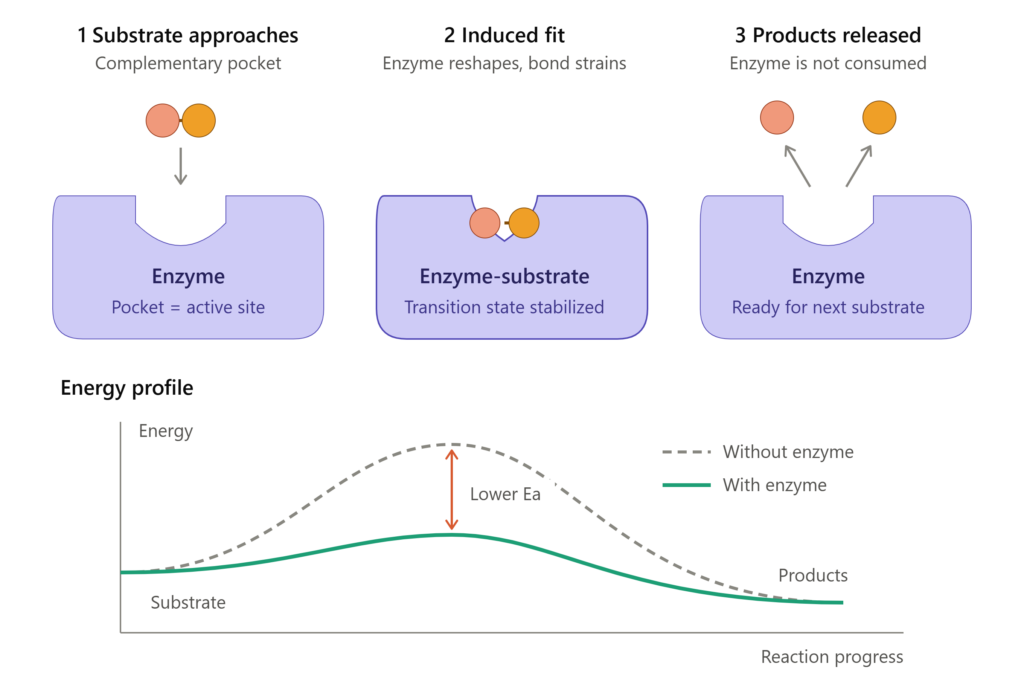
Enzymes speed reactions by lowering activation energy. Their active sites interact with substrates, and the fit can adjust during binding. (openstax.org)
- Biological catalysts: Accelerate biochemical reactions by lowering the activation energy required without being consumed in the process.
- Active site & substrate specificity: Substrates bind to the specific 3D pocket of the active site through complementary shape and chemical properties.
- Induced-fit model: Binding triggers subtle conformational changes in the enzyme to optimize active site alignment and stabilize the transition state.
- Environmental factors: Temperature, pH, and substrate concentration alter reaction rates; extreme heat or pH shifts cause denaturation by disrupting non-covalent bonds.
Inhibition & regulation: Competitive inhibitors block the active site directly, while non-competitive (allosteric) inhibitors bind elsewhere to alter active site shape.
What should you look for in a biology tutor?
Look for relevant subject knowledge, experience with your course level, and an ability to make your reasoning visible. Ask for specific qualifications and teaching experience rather than treating a polished profile as proof of fit. A useful introductory conversation should also establish what you need and how progress will be reviewed.
Use these questions when evaluating a potential tutor:
- Course alignment: Have you supported learners studying this level and curriculum? Can we use my syllabus and teacher’s terminology?
- Teaching approach: What would you do if I still did not understand after your first explanation?
- Independent practice: How would you check whether I can solve a similar problem without help?
- Working arrangements: What happens between appointments, and what communication or materials are included?
Advertisements for online biology tutor jobs may describe desired credentials, but they do not establish an individual tutor’s qualifications. Ask what that person actually holds and how their experience relates to your needs.
If you’re also considering an online science tutor for several subjects, discuss the biology topics involved. Request examples of how they would teach the material you currently find difficult, rather than relying on a broad subject label.
Build a study plan around your next milestone
Give each appointment a job. For a near-term test, that might mean identifying weak areas and working through representative questions. For a longer-term goal, it might mean revisiting prerequisite ideas while keeping pace with current coursework. Agree on priorities before trying to cover everything.
A manageable study cycle could look like this:
- Before the session: Attempt a few questions and mark the exact point where you become unsure.
- During the session: Examine one or two priority difficulties, then attempt a new example yourself.
- After the session: Write a short explanation from memory and check it against your materials.
- At the next review: Return to errors and decide whether the topic needs more work or a harder application.
The memory-based step is deliberate: recalling information is a learning activity, not merely a way to measure performance. Check your response afterward so misunderstandings become opportunities for correction rather than rehearsed errors. (ctl.wustl.edu)
Keep the schedule realistic. Choose practice you can complete between appointments, and leave room to revise the plan when school deadlines change.
How can you tell whether tutoring is helping?
Check whether you can do more independently on the skills you targeted. Use comparable tasks before and after a period of support, and distinguish between recognizing an explanation and producing one yourself. Grades matter, but they need not be your only checkpoint.
How can an a level biology online tutor help with exam preparation?
An a level biology online tutor helps you connect detailed theory to mark schemes, refine your exam technique, and master complex topics such as genetic engineering or cellular respiration.
What is the difference between an a level biology physics and maths tutor and a biology specialist?
An a level biology physics and maths tutor can support STEM subjects comprehensively, which is useful for cross-disciplinary topics like mathematical modeling or data analysis, whereas a specialist focuses deeply on biological principles.
What should I look for in an a level biology tutor online?
Look for an a level biology tutor online who has deep knowledge of your specific exam board (such as AQA, OCR, or Edexcel) and who uses active retrieval methods during sessions.
How to become a biology tutor?
If you are interested in how to become a biology tutor, start by gaining a strong academic degree in life sciences, developing familiarity with current specification requirements, and building teaching or mentoring experience.
Make your next session count
Before seeking biology help online, gather your syllabus, recent feedback, relevant notes, and one attempted problem. Write a specific request: “I can identify the structures, but I cannot explain their roles” gives a clearer starting point than “I’m bad at biology.” Check your connection and prepare a way to share diagrams or handwritten work.
When choosing a biology tutor online, look for a partnership that leaves room for your questions and your own attempts. If you’re considering MTK Tutoring, share your course level, upcoming deadlines, and the concepts you want to tackle, then ask about suitable support and availability. The goal is not simply to get through the next worksheet—it is to build understanding you can use without someone beside you.