
Finding the Best Calculus Tutor Nearby
The best calculus tutor for you is someone who understands your course, explains ideas clearly, and helps you solve problems independently—not simply the closest person available. If you’re searching for a “calculus tutor near me,” start by identifying where you get stuck, then compare subject experience, teaching style, scheduling, and total cost. Here’s how to turn search results into a practical shortlist and choose support that fits.
How do I find the right calculus tutor near me?
Find the right calculus tutor by matching candidates to your exact class and learning needs, then evaluating how they teach before making a longer commitment. Use location to narrow your options, but make course knowledge and clear communication your deciding factors. Ask prospective tutors to review your syllabus and discuss a problem you struggled with.
Before searching, write a short description of what you need. “Help with math” leaves too much unanswered; “Calculus II help choosing convergence tests before my next exam” gives a tutor something specific to assess.
Build your shortlist through several routes:
- Your school: Ask your instructor, counselor, or academic support office about tutoring resources and referral options.
- Local searches: Add your city, neighborhood, campus, or preferred meeting area to your query.
- Personal recommendations: Ask what the tutor actually did during sessions, not just whether someone liked them.
- Tutor profiles: Look for explicit course coverage and a clear explanation of the teaching process.
A broad search for “math help near me” is a starting point. Follow it with course-specific questions before booking.
Match the tutor to the math you’re taking
Bring your actual syllabus into the conversation rather than relying on a tutor’s general description of “advanced math.” Ask them to identify which upcoming topics they teach confidently and whether anything falls outside their scope. Their response should help you decide whether to continue the conversation.
Precalculus and foundational skills
College Board lists algebra, geometry, trigonometry, and elementary functions among the recommended preparation for AP Calculus AB. Its guidance also emphasizes graphing functions, solving equations, and working with function compositions and inverses. (apstudents.collegeboard.org) If those are the steps where your work breaks down, consider whether a “pre calculus tutor near me” search better describes your immediate need. Ask a prospective tutor to examine both your calculus reasoning and the supporting algebra. You want a plan that addresses the specific gaps without automatically restarting an entire earlier course.
AP Calculus AB and BC
If you’re searching for an “ap calculus tutor near me,” specify AB or BC immediately. AP Calculus AB covers differential and integral calculus, including limits, derivatives, integration, and their applications. Ask candidates how they connect those topics rather than teaching each procedure in isolation. (apstudents.collegeboard.org) For a “calculus ab tutor near me” search, prioritize someone who can coach written reasoning as well as calculations. College Board identifies justifying solutions, connecting representations, and using correct mathematical notation as course skills. (apstudents.collegeboard.org) An AP Calculus BC tutor should also be comfortable with parametric equations, polar coordinates, vector-valued functions, and infinite sequences and series. These appear explicitly in the BC course framework. When comparing “ap calculus tutors near me,” ask about your specific course rather than accepting “AP experience” as sufficient detail. (apstudents.collegeboard.org)
College Calculus II and multivariable calculus
For a “calculus 2 tutor near me” search, name the topics you need. For example, the University of Illinois Calculus II syllabus includes integration techniques, improper integrals, sequences and series, parametric curves, and polar coordinates. Use your own syllabus to confirm the required scope. (math.illinois.edu) If you need a multivariable calculus tutor, ask about partial derivatives, multiple integrals, and vector calculus. Those topics appear in Illinois’s Calculus III syllabus, alongside three-dimensional geometry and vector functions. When searching for a “calculus 3 tutor near me,” share upcoming assignments so candidates can assess the match directly. (math.illinois.edu)

Should you choose in-person tutoring or tutoring online?
Choose the format that lets you participate actively and attend consistently. For in-person tutoring, assess the meeting space and travel requirements; for tutoring online, test how you will write equations, share work, and ask questions. Neither option deserves your commitment until you’ve checked those practical details.
If you prefer sitting beside someone with paper and pencil, prioritize a convenient, appropriate location. Confirm whether sessions happen at a tutoring center, library, school, or another agreed setting. For a younger student, clarify supervision and communication arrangements with a parent or guardian.
For online sessions, request a brief technology check. Make sure the tutor can see your working—not just hear your final answer—and that you can read their notation comfortably.
Compare these essentials before deciding:
- Participation: Can you write, sketch, and explain your thinking easily?
- Consistency: Does the arrangement fit your normal weekly schedule?
- Access: Can you retrieve any shared notes afterward?
- Backup plans: What happens if the meeting space becomes unavailable or the connection fails?
Look for teaching you can evaluate
Ask a prospective calculus tutor to describe a typical session using a concrete example from your course. Listen for opportunities for you to attempt problems, explain decisions, and revisit mistakes. Treat “I’ll help you finish your homework” as incomplete until they explain how they will check your understanding.
Useful screening questions include:
- “How would you assess my starting point?” Request a brief review of your work and a few targeted questions rather than an automatic lesson package.
- “What happens when I don’t understand your explanation?” Ask for an example of another representation or approach they might try.
- “How will we track progress?” Suggest checking whether you can solve a fresh problem without prompts.
- “What should I do between sessions?” Ask for a manageable practice plan tied to your current difficulties.
Read reviews with those questions in mind. Look for descriptions of the tutor’s approach, then verify the details that matter to you directly. Ask about experience teaching your course, not only studying it, and clarify any credentials listed on a profile.
Be cautious about guaranteed grades or scores. Ask what work the tutor expects from you and how they would adjust the plan if progress stalls.
Use the first session as a working assessment
Treat an initial session as a chance to evaluate the relationship, not a promise to continue indefinitely. Bring your syllabus, recent feedback, attempted homework, and the date of your next assessment. Include unfinished work: it gives the tutor something specific to discuss with you.
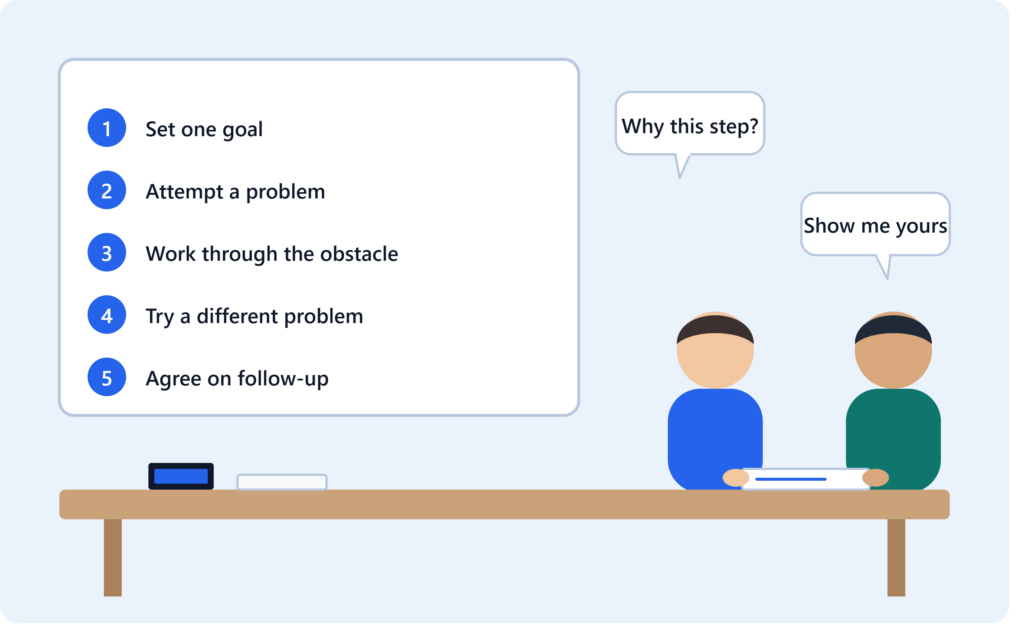
You can propose this session structure:
- Set one goal. Choose a focused task, such as identifying when to use integration by parts.
- Attempt a problem. Explain your choices aloud and show where uncertainty begins.
- Work through the obstacle. Ask the tutor to address the reasoning behind the step, not merely supply it.
- Try a different problem. Request a new example to attempt with less assistance.
- Agree on follow-up practice. Leave with a short list of tasks and a clear next priority.
Afterward, judge the experience using evidence. Could you explain the central idea in your own words? Did you have enough time to think? Were mistakes discussed respectfully?
You don’t need to leave understanding everything. Before booking again, you should understand what you worked on, what remains difficult, and what the next session would address.
Compare the full commitment before booking
Request a written explanation of pricing and session policies before agreeing to ongoing tutoring. Ask about session length, preparation charges, travel fees, cancellation deadlines, and any minimum purchase. If a package is offered, clarify its expiration and refund terms.
Compare options against the same checklist:
- Course fit: Has the tutor confirmed the topics you need?
- Teaching fit: Did the initial conversation or session give you enough opportunity to participate?
- Practical fit: Can you maintain the schedule and meeting arrangement?
- Budget fit: Do you understand the full commitment, including possible extras?
Before purchasing private sessions, check what support your school makes available and whether you’re eligible to use it. Ask about office hours, peer support, or tutoring appointments rather than assuming what is included.
Set a review point with whichever tutor you choose. Revisit whether you can start unfamiliar problems, justify your steps, and identify errors with less help. Use that conversation to adjust the focus, schedule, or arrangement.
Choose support that builds independence
Your search should end with a clear match, not simply a nearby name. Start with your course and specific obstacles, compare a small shortlist, and use an initial session to evaluate the teaching. Choose the tutor whose plan makes sense to you—and keep checking that the work is moving toward problems you can solve on your own.